


FAQ: PowerHub 500
& PowerPack 500
Everything you need to know about PowerHub 500 and PowerPack 500. Below you'll find answers to the questions heavy-duty fleet operators ask us most — from charging performance and scalability to software, service and total cost of ownership. The questions are organised into two areas so you can go straight to what's relevant for you.
Shell PowerHub 500
PowerHub 500 is the charging hardware – purpose-built for the realities of heavy-duty depot operations. These questions cover charging performance, scalability, installation, operation and service.
Difference to conventional charging setups
Placeholder
This entry is only there so that the accordion can be completely closed.
How does PowerHub 500 compare with conventional high-power chargers?
The system combines sustained high-power charging, liquid-cooled power module technology, dynamic power sharing across up to six DC outputs, backend connectivity, and service integration. This helps fleet operators reduce complexity across hardware, software, service, access control, and daily charging operations.
For logistics operators, the benefit is a charging system designed around depot realities: predictable performance, fewer vehicle movements, efficient use of grid capacity, scalable infrastructure, and reliable vehicle availability.
Why should a fleet operator choose PowerHub 500 instead of a standard HPC charging setup?
PowerHub 500 is designed for heavy-duty depot charging. It combines sustained high-power performance, dynamic power sharing across up to six DC outputs, scalable system architecture, backend connectivity, and service integration.
This helps operators reduce vehicle movements, use available grid capacity efficiently, scale infrastructure as the fleet grows, and maintain reliable vehicle availability in daily operations.
What makes PowerHub 500 specifically suited for heavy-duty depot operations?
The system supports multiple charging outputs from one shared power unit, dynamic power allocation, optional load management, and a scalable hardware architecture. This makes it particularly suitable for depots where charging infrastructure must support daily operations rather than simply provide individual high-power charging points.
What makes PowerHub 500 special compared with previous SBRS hardware?
PowerHub 500 is purpose-designed for heavy-duty vehicles and built around the key criteria that matter most for fleet operators: sustained performance, uptime, scalability, serviceability, and operational reliability.
Scalability and system configuration
Placeholder
This entry is only there so that the accordion can be completely closed.
How many vehicles can PowerHub 500 charge at the same time?
The fully expanded satellite system – combining the All-in-One unit with two dual-dispenser units – enables up to six vehicles to charge at the same time, with dynamic power sharing across all six DC outputs.
Can a fleet operator start small and expand the system later?
The All-in-One unit is prepared to connect up to four additional DC outputs / CCS connectors. These can either be pre-configured from the factory or added later in the field as the customer’s electric fleet grows.
This allows operators to invest in charging infrastructure step by step instead of over-investing in capacity before it is needed.
What does “up to six outputs” mean in practice?
This means the system can grow in line with fleet electrification. Operators can begin with a smaller setup and expand charging capacity as more electric trucks or buses are added to the fleet.
Can multiple PowerHub 500 systems be combined for larger depots?
Dynamic power sharing operates within each PowerHub 500 system and is available across the DC outputs connected to a common power unit.
What configurations will be available at launch?
In total, five hardware configurations will be available for ordering. The Power Unit All-in-One is always configured with oil-cooled 500A ports. The dual-dispenser unit can be ordered in either uncooled or cooled configuration:
- Power Unit All-in-One only – 2 DC outputs in total
- Power Unit All-in-One + 1 uncooled dual-dispenser unit – 4 DC outputs in total
- Power Unit All-in-One + 1 cooled dual-dispenser unit – 4 DC outputs in total
- Power Unit All-in-One + 2 uncooled dual-dispenser units – 6 DC outputs in total
- Power Unit All-in-One + 2 cooled dual-dispenser units – 6 DC outputs in total
Thermal management, derating and reliability
Placeholder
This entry is only there so that the accordion can be completely closed.
Can PowerHub 500 deliver full power under European ambient conditions?
How does PowerHub 500 avoid power derating under heavy-duty load?
Air-cooled architectures therefore have inherent limitations when managing high-density heat loads. By contrast, the liquid-cooled architecture used in PowerHub 500 enables more effective thermal management, helping to prevent hotspots and maintain stable, continuous charging performance over longer periods.
How does the liquid-cooled design impact maintenance and lifecycle cost?
For fleet operators, this can contribute to lower lifecycle costs, fewer service interventions, and higher charging availability.
What happens if one output or component fails? Does the whole system go down?
Fallback modes help ensure continued operation, supporting high availability in daily fleet operations.
What level of uptime is PowerHub 500 designed for?
Its fault-tolerant architecture supports continued operation even in the event of single-component failures, such as individual power modules or switching relays.
The system is built on SBRS’s experience from more than 80 fleet depot projects, all designed to meet the highest demands on charging availability and duty cycles.
Operation, access and payment
Placeholder
This entry is only there so that the accordion can be completely closed.
How can fleet operators monitor and manage charging operations remotely?
PowerHub 500 will be launched with connectivity to the SBRS service backend and can be integrated with software such as a Charge Point Management System.
This enables operators to manage charging infrastructure more efficiently, monitor operations remotely, support service processes, and prepare for advanced functions such as scheduled and prioritised charging.
How does PowerHub 500 integrate into fleet operations, access control and billing?
Depending on the use case, this can include access control, authentication, billing-related processes, service backend connectivity, and Shell Card-based charging workflows.
Can access be controlled for different users, vehicles or operating models?
Driver-, vehicle-, card-, and operating-model-specific access rights can be defined in line with the operational needs of the fleet operator.
What payment and authentication options are supported?
For private or subcontractor charging of pre-registered vehicles, PowerHub 500 supports Shell Card / RFID and Autocharge authentication.
For semi-public charging, it offers the same payment and authentication options as Shell’s public charging network, including the Shell Recharge App, Shell Recharge Card, Shell Card, debit and credit cards such as Mastercard and Visa, Apple Pay, Google Pay, and third-party roaming cards accepted across the roaming network.
Is subcontractor charging supported?
Charging prices are configured based on subcontractor contracts, while the reimbursement price is set in line with the depot operator’s actual energy costs. This ensures alignment with the operator’s real cost structure.
Can PowerHub 500 support private, subcontractor and semi-public charging use cases?
The system can support private fleet charging, subcontractor charging, and semi-public charging use cases. Certain connectors can be used for private or subcontractor charging, while others can be configured for public or semi-public access – all powered by a single power unit.
This can improve utilisation and strengthen the business case for mixed-use depot operations.
It is important to note that product readiness for semi-public use is expected two to three months later than private eDepot readiness. Semi-public operation requires additional technical assurance testing beyond the type testing performed for CE marking.
Service, quality and lifecycle cost
Placeholder
This entry is only there so that the accordion can be completely closed.
How does the service model help minimise downtime?
Depending on the selected service tier, hotline support can be available during business hours or 24/7. Reaction times are defined per SLA tier and contractually committed.
The service model is designed to support high availability, fast issue resolution, and reliable fleet operations.
What service packages are available?
Preventive maintenance is available across both tiers, with commercial terms varying by package and available upon request. Reaction times are clearly defined per SLA tier and contractually committed.
What warranty coverage is included?
How does SBRS ensure reliable performance before delivery?
SBRS is ISO 9001 certified and governed by a quality management system.
How does SBRS ensure quality, reliability and serviceability?
The system is supported by SBRS’s heavy-duty charging expertise, quality management processes, Factory Acceptance Testing, and a multi-level service concept.
Which factors can help reduce total cost of ownership?
Operational benefits can include fewer delays, less driver coordination, reduced yard movements, improved utilisation of charging infrastructure, and more efficient use of available grid capacity.
What is the efficiency or energy loss profile compared with other chargers?
For fleet operators, higher efficiency can help reduce energy losses and lower operating costs over the lifetime of the system.
Commercial availability and project start
Placeholder
This entry is only there so that the accordion can be completely closed.
When will PowerHub 500 be commercially available?
What is the expected timeline from order to operational charging?
Electrical installation can usually take place in parallel. Commissioning typically takes one to two weeks after the system has been electrically installed.
The exact timeline depends on site readiness, grid connection, installation scope, permitting requirements, and project-specific conditions.
How can a fleet operator start a PowerHub 500 depot project?
Fleet operators can send their project information to inquiry@sbrs.com. A sales representative will then contact them to discuss further details, proposal scope, and timelines.
For a qualified project discussion, relevant information may include depot location, fleet size, vehicle types, charging windows, available grid capacity, expected rollout timeline, and future expansion plans.
Which commercial models are available for fleet operators?
The core offering is PowerHub 500 delivered as a bundled solution together with selected SBRS products and services.
While an as-a-service model is not offered as a standard option, SBRS is open to exploring this commercial model where it is combined with a Shell energy procurement agreement as part of the overall solution.
How much does PowerHub 500 cost?
Project-specific pricing depends on selected configuration, service package, software scope, installation requirements, and any optional add-ons.
Explore more
PowerHub 500
Scalable DC charging hardware – purpose-built for heavy-duty fleets
Shell PowerPack 500
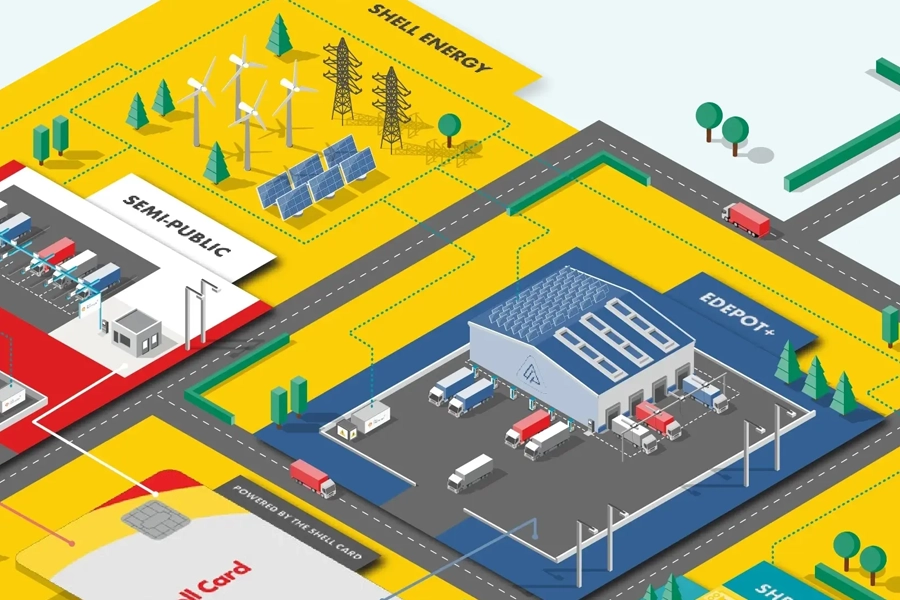
PowerPack 500 builds on PowerHub 500 and adds everything around it – software, service and Shell Card – in one bundled solution. So you deal with one provider instead of many. Find out what’s included, how the commercial model works, and where it saves time and cost.
Hardware and bundle structure
Placeholder
This entry is only there so that the accordion can be completely closed.
Is PowerPack 500 available as a standalone hardware purchase?
Any deviation from the bundled offering requires project-specific review and may only be considered on an exceptional basis, depending on specific project requirements.
Do customers need to take all components of the bundle?
Can customers customise which elements they include in PowerPack 500?
What optional add-ons are available beyond the standard package?
The ERE claiming service is only possible in combination with the Dynamic Load Management option, as the service requires local site metering.
Shell Card, access and payment
Placeholder
This entry is only there so that the accordion can be completely closed.
How does Shell Card support access, payment and billing?
Shell Card enables access to Shell’s network and supports unified payment, subcontractor contract fulfilment and billing across locations.
How does Shell Card simplify charging operations?
I already use a fleet or charging card from another provider. Can I continue to use it?
Can customers generate revenue with PowerPack 500?
In this setup, Shell acts as a contract fulfilment partner, managing billing and invoicing of subcontractor charging sessions and facilitating reimbursement to the eDepot site owner based on the agreed commercial terms.
Semi-public charging is currently not supported and is not included in PowerPack 500. Launch is planned for H2 2026.
How does PowerPack 500 connect depot charging with a wider charging network?
PowerPack 500 supports depot-based charging operations and can connect them with Shell’s wider charging network through Shell Card-based access, payment and billing processes.
This allows fleet operators to combine private depot charging with selected subcontractor, semi-public or public charging use cases, depending on the operating model and project scope.
Total cost of ownership and operational value
Placeholder
This entry is only there so that the accordion can be completely closed.
How does PowerPack 500 help reduce total cost of ownership?
PowerPack 500 can help reduce total cost of ownership through several factors:
- Low maintenance costs: liquid-cooled modules can help extend the charger’s lifetime and reduce maintenance and replacement costs.
- Low OPEX: advanced power module technology allows for high efficiency and lower electricity losses, reducing energy consumption and energy costs.
- Higher operational efficiency: reduced maintenance and replacement can support higher charger uptime, resulting in fewer operational delays and higher charger utilisation.
- Shared core unit: one infrastructure supports up to six ports and multiple use cases for improved return on investment.
- Phased investment approach: customers can invest in infrastructure as their needs grow, rather than ahead of time.
- Revenue generation: PowerPack 500 is enabled with technology that allows customers to open their eDepot to third parties, increasing utilisation and potentially generating revenue.
- Market EV credits: with the EV Credit as a service option in the Netherlands, Shell can support customers with claiming JaRI certificates, which can reduce eDepot charging costs by up to €0.15/kWh, subject to market value.
- Bundled to save time and effort: with one trusted provider covering charging hardware, CPMS, servicing and maintenance, and Shell Card, fleets can deploy faster and operate more efficiently, for example with less driver coordination.
How does PowerPack 500 reduce complexity compared with multiple suppliers?
Instead of coordinating separate providers for hardware, software, service, payment and access, customers receive an integrated setup designed to support heavy-duty depot operations from the start.
Explore more
PowerPack 500
Start your fleet electrification with Shell’s all-in-one package
Related topics


Contact us
Questions about your fleet?
We’re here to support you.