

26th June, 2026
Shell Business Recharge Solutions (SBRS) megawatt charging innovation contributes to major industry research

Partner Stories
Insights
Innovations
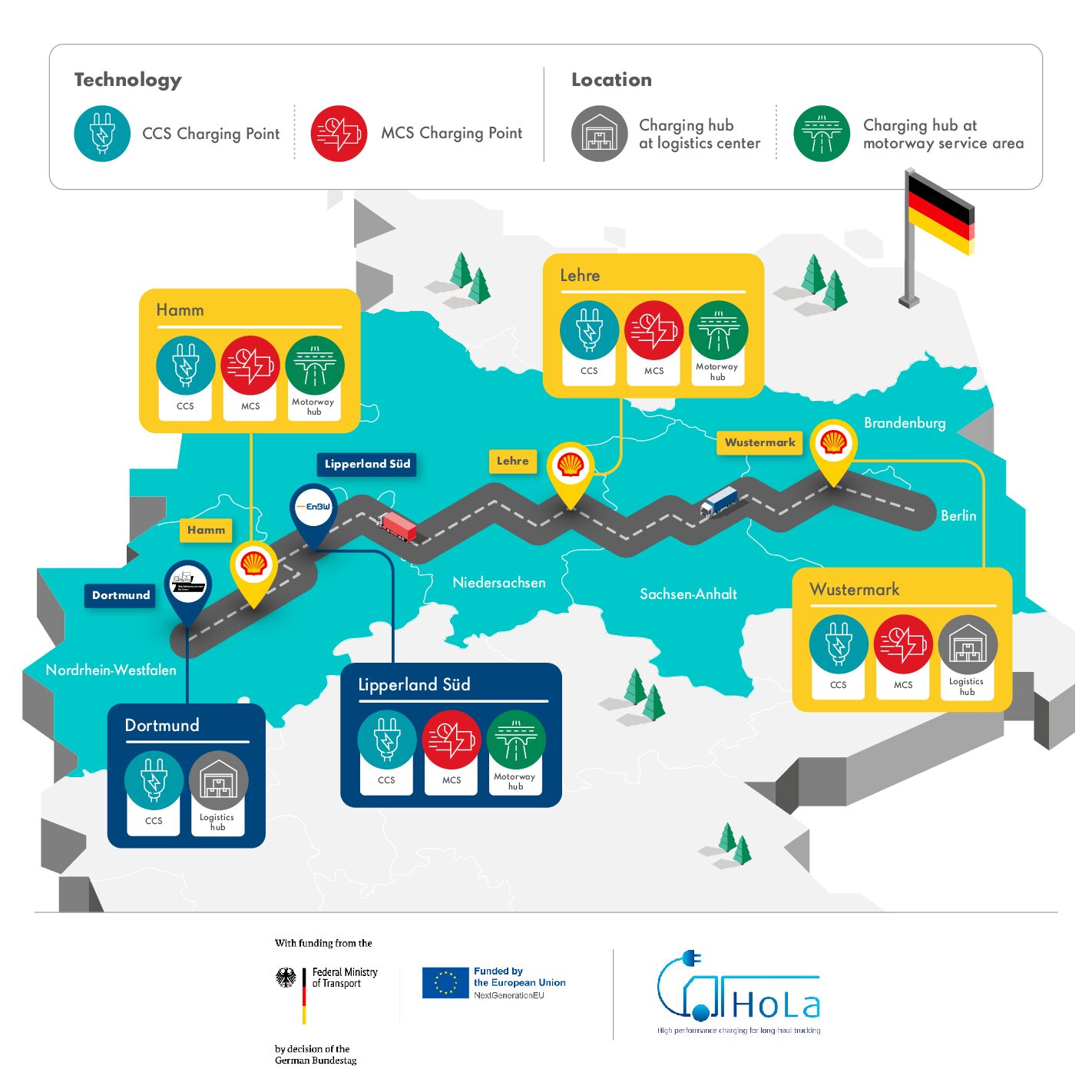
Picture: HoLa – Map
A 40-ton truck sets out to make a fully electric 500 km journey across Germany. It departs Berlin with a full battery, but for the long-haul route to Duisburg to work, the truck’s going to need powerful, ultra-fast charging along Germany’s A2 Autobahn – one of the most important logistics corridors in Europe. The kind of charging that tops up a heavy-duty truck battery while the driver takes a 45-minute break.
We at Shell Business Recharge Solutions (SBRS) develop our own charging hardware and deliver integrated high-power charging solutions for electric heavy-duty transport.
In this context, SBRS contributes to the HoLa (High Performance Charging for Long-Haul Trucking) project, a German federally funded research initiative focused on the electrification of heavy-duty transport.
The project involves 13 industry consortium partners, including energy companies, truck manufacturers, infrastructure providers, and research institutes.
Bringing together industry and research partners, HoLa is testing megawatt charging under real operating conditions to inform the rollout of high-power end-to-end charging infrastructure.
The A2 demonstrator corridor is central to the HoLa research. Of the five participating sites, three are owned by Shell. These sites will provide a mix of MCS and CCS charging technologies, designed to support fleets with different operational needs. SBRS has equipped high-powered Megawatt Charging System (MCS) technology at two of these Shell sites.

Picture: HoLa, Opening-Ceremony in Lehre
The power of charger innovation
At these two Shell HoLa sites (Lehre and Wustermark), SBRS has installed a megawatt charging system based on the newly published megawatt charging standard for design and communication.
Unlike slower Combined Charging System (CCS) charging, MCS enables electric trucks to recharge enough during a standard break to continue their journey for several hundred kilometres, without extending downtime or disrupting established driving and rest schedules. This connection – between reliable, ultrafast charging and daily logistical requirements – makes long-distance electric trucking operationally viable.
Installing MCS chargers at public sites requires technical innovation and advanced solutions. The heat generated during MCS charging can be up to nine times higher than in
CCS charging and must be controlled over the full charging session. A single MCS session at 1.2 MW consumes approximately the same power as the peak electrical load of a residential block with 1,000 apartments.
We addressed these challenges through extensive pre-installation testing, including climate-chamber trials, to ensure the MCS system performs reliably in real-world conditions. But the real test starts now – when the HoLa demonstrator corridor officially opens and 12 trucks begin to gather data and insights into how vehicles, charging hardware, and logistics operations interact out in the field.
Reliable corridor megawatt charging can be a crucial piece of the electrification puzzle – but depot charging (typically CCS) remains the backbone of many electric fleet operations.
Building an integrated charging ecosystem
By connecting private, semi-public, and public infrastructure, an integrated charging ecosystem can be created that supports fleets with different operating models.
Today high upfront infrastructure investments and overall total cost of ownership remain key challenges for electrification. But a recent Shell report (“Electric Trucking: From Cost Barrier to Competitive Advantage”) on the electrification of heavy-duty transport shows that, in addition to lower energy and maintenance costs, modular investments and additional revenue streams in particular can improve the business case for electric fleets.
By connecting to the Shell charging network and enabling access via the Shell Card, operators can also open their charging infrastructure to external users. This allows them to further optimize their total cost of ownership (TCO), depending on individual operating and market conditions.
From first steps to full-scale electrification
Fleets without depots benefit from shared charging infrastructure too, but many are searching for a practical, scalable entry point into eDepot operations. Modular chargers enable operators to act now – starting with the infrastructure they need first and expanding in line with business growth.
As more corridors and charging networks emerge, the cost-effective path toward long-haul electrification might become clearer: combining powerful on-route charging with depot infrastructure and integrated charging solutions.
For SBRS, participation in the HoLa project is first and foremost an opportunity to learn. Research projects like this allow us to gain hands-on insights into how high-power charging
technology performs under real operating conditions – and how vehicles, charging hardware and energy systems interact along key logistics routes.
These insights are essential for continuously improving our solutions and ensuring that future generations of charging infrastructure are even more robust, efficient and fit for the real requirements of heavy-duty electric transport.
Video: HoLa Video
Project HoLa (High Performance Charging for Long-Haul Trucking) is funded under the German electromobility funding guidelines with a total of almost 10 million euros by the Federal Ministry of Transport (BMV). Funding for this measure is also provided under the German Recovery and Resilience Plan (DARP) through the European Recovery and Resilience Facility (RRF) within the NextGenerationEU programme. The funding guideline is coordinated by NOW GmbH and implemented by the Project Management Organisation Jülich (PtJ).