

28. Aug. 2026
How electric trucks can beat diesel on total cost of ownership

News
Insights
Innovations
Electric trucking has the potential to achieve a lower total cost of ownership under certain operating conditions. So why is there a perception that it can’t?
It can be tempting to see electricity as a like-for-like replacement for diesel – simply swapping one power source for another. But electricity introduces new ways to manage costs, access incentives and generate value. When fleets move beyond vehicle comparisons and look at the wider charging ecosystem, those opportunities begin to change the economics of trucking.
Focusing on vehicle cost overlooks the wider energy system
Because electric trucks typically carry a higher upfront price than comparable diesel vehicles, they can appear to be the more expensive option. But electric trucking economics are shaped by more than the vehicle itself.
Electric operations introduce a new energy source, new infrastructure and new networks – along with the opportunity to turn these factors into a genuine operational asset.
A fair comparison therefore needs to consider the full operating system around the vehicle. Electricity does not simply replace diesel as a power source. It gives fleets access to commercial and operational levers that diesel operations may not be able to access.
How electricity can reduce fleet costs versus diesel
When comparing diesel and electricity, there are three important economic levers for fleets to consider:
- Electricity can be optimised
Electricity prices can vary throughout the day, particularly during periods of high demand. Smart charging allows fleets to schedule charging during lower-cost periods (such as overnight) while making sure trucks are ready for their next duty cycle.
There’s also the opportunity to balance energy demand across multiple charge points. Rather than allowing every connected vehicle to draw maximum power simultaneously, charging can be managed according to vehicle schedules, energy availability and operational priorities.
When combined, smart charging and energy management can reduce energy costs by up to 30%.[1]
- Electricity unlocks incentives
In some European markets, electric trucks can benefit from exemptions or reductions for zero-emission transport under road-tolling schemes.
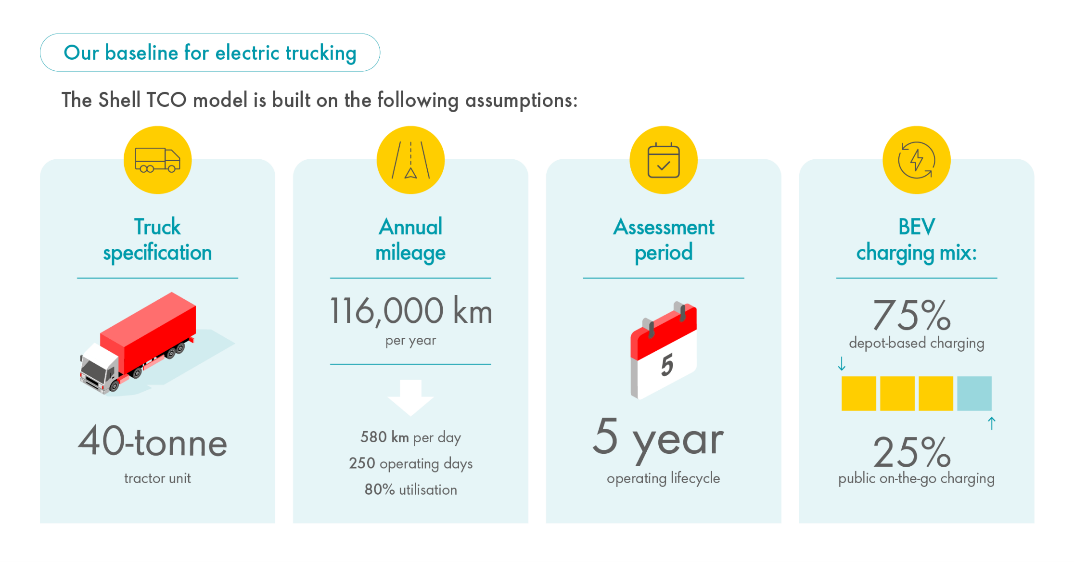
For example, in Germany, electric trucks are exempt from the MAUT road toll scheme until at least 2031.[2] This means that a single 40-tonne truck travelling 116,000 kilometres a year could be exempt from more than €150,000 of tolling fees over five years.[3]
Diesel operations are also likely to come under increased regulatory pressure. For instance, the EU’s Emissions Trading System for Buildings and Road Transport (ETS2) is expected to come into effect from 2028, introducing additional carbon costs for road transport.
- Electricity can drive revenue
One significant advantage electricity has over diesel is the value it can create beyond serving a fleet’s own vehicles.
Private depot charge points may only be required during defined charging windows. When a fleet’s trucks are on the road, that unused capacity can be opened to other operators, generating income from third-party charging sessions.
This is known as semi-public charging, and the revenue generated from this approach can offset – and in some cases exceed – a fleet’s own energy costs.
Why an integrated charging network is the key to lowering electric TCO
Each of these economic levers can improve fleet economics individually. However, the strongest results emerge when they work together within one connected ecosystem.
Shell’s modelling shows that fleets using an integrated charging network and services can achieve up to 10% lower TCO compared with diesel.[4] The advantage doesn’t come from changing the route, workload or operational demand. It comes from changing the wider system supporting the fleet.
To change that system, fleets need charging infrastructure designed around their specific operations and vehicle schedules. Energy management must work alongside charging access, while systems for authentication, payment and settlement need to support the fleet and any third-party users.
An integrated charging network brings these elements together. It connects depot infrastructure with energy optimisation and wider network access, helping fleets capture value across the system rather than treating each component as a separate investment.
Building the business case for electric fleet growth
Capturing the benefits of electrification starts with understanding where value exists within a fleet’s operations.
Shell’s TCO calculator helps operators compare electric and diesel operations under real-world conditions. It highlights the operational and commercial levers that can help reduce electric trucking TCO – helping fleets plan their electrification journey with greater confidence.
From there, fleets can start developing infrastructure that supports current operations and future growth.
Shell PowerPack 500 provides a cost-effective, scalable entry point to depot charging. Fleets can begin with the charging capacity they need today, then expand as electric vehicle adoption grows.
This infrastructure enables fleets to connect to Shell’s integrated charging network and start generating additional revenue by opening their charge points up to third-party operators.
Integrated solutions – including energy management, access to a growing network of public charging locations and simplified payments via Shell Card – can then help fleets deliver more value from their electric operations.
It’s time to think differently about electrification
Fleet operators can overlook the opportunities of electrification by comparing electric and diesel trucks as like-for-like replacements.
But as electrification scales, fleets that take a system-wide approach may be better positioned to reduce costs and build a competitive advantage.
Download the white paper, Electric Trucking: From Cost Barrier to Competitive Advantage, to explore how fleet electrification can beat diesel on total cost under the right conditions: https://www.sbrs.com/tco-pro-report/?utm_source=sbrs_webpage_blog&utm_medium=webpage&utm_campaign=tco_report_launch
[1] The actual savings are highly dependent on the customer use case, other customer inputs such as energy prices, cost of infrastructure, and geography. Energy savings are estimated using the Gridcog web-based tool for energy optimisation.
[2] In 2025, the EU extended the full exemption for zero‑emission heavy‑duty vehicles from road tolls until 30 June 2031 under the Eurovignette Directive: European Commission. “EU backs extended toll exemption for zero emission trucks.” 2025.
[3] Versus an equivalent Euro 6 truck of >18 tonnes in CO2 emission class 4, incurring toll fees of €0.348/km across 75% of its mileage: Toll Collect Germany. “Toll rates.” N.D.
[4] Potential TCO outcomes are based on Shell’s model for a heavy-duty truck operating 116,000 km/year over 5 years, which was subsequently adopted by Shell. The model assumes a semi-public, energy-optimised eDepot with 75% private and 25% on-the-go charging. Estimated savings come from third-party eDepot use, Smart Charging energy cost reductions, and preferential network pricing, based on market references (excluding grid upgrades). Actual results will vary by market, vehicle type, and customer-specific factors such as energy prices, infrastructure costs, utilisation, and location.